

Table of Contents
😱 FOMO

It’s hard not to laugh at this meme because it’s so true. With all the talk about GenAI, you’d think that companies would be executing tons of valuable use cases. But that isn’t what’s happening. This could be due to various reasons ranging from lack of dev resource to no clear clue about where to get started from.
Aman wrote this blog post talking about how anyone can build the right AI product or feature using this 5 step approach. Give it a try.

In this edition we will be talking about how you can implement a quick AI use case and chances are that it won’t cost you an entire quarter product roadmap.
This way giving you bragging rights of a GenAI company. 😉
The “Quick Win” Approach
The savviest leaders are good at stringing small wins together in a way that leads to big change over time. The key is to find incremental changes that each can pay for themselves and create momentum for more. This approach embodies many of the same principles that agile product teams use to build elaborate products over time.
I start here because so much of today’s GenAI hype is focused elsewhere. It’s fun to look to the horizon and imagine the long-term implications of AI. It’s also easy to be distracted by the sheer volume of daily “AI news”. For those that want to lead companies into the future, the key is to get started. And the best way to start is to apply agile thinking to deliver tangible value fast.
But how do you find such a use case? One that’s quick, valuable and which lays the foundation for the next step. Charting this course isn’t easy, but knowing that this is the path to success will get you focused in the right place.
The 3 Lanes of GenAI
AI hype is everywhere. You need frameworks to organize your thinking and your actions. Here’s one that I’ve found to be helpful when working with others:

Each lane in this framework has pros and cons. Nearly every company has people using AI on an ad-hoc basis to do their work. Most companies also use an assortment of packaged applications that include GenAI capabilities. Fewer companies have embedded GenAI into their existing products and custom applications and even fewer have built new custom GenAI-powered tools from scratch. The reason the third lane is so empty is that building these applications requires investment, frameworks and skill sets which are in short supply at most companies.
Companies that learn to apply GenAI in ways that are unique and specific to their business will create competitive advantage.
Yet this is rarely the place to start. Better to get started with a proven GenAI use case that delivers tangible value quickly. Here is a common and widely applicable example of one …
Example - “Semantic Search for Staff”
Every business has employees and anyone who’s had to onboard new employees knows that there’s a lot to teach the new hires before they become fully productive. Even long-term employees occasionally have questions and a need to refer to procedures or policies.
The answer to this need has evolved over time from printed manuals and binders (for those that are old enough to remember this), to Lotus Notes (for a short time), to web-based knowledge bases. Each step improved on the prior approach in some way. It’s easy to see how GenAI will supplant (or at least augment) the web-based knowledge base by proactively guiding new hires through onboarding and by allowing employees to have their questions answered the way you’d answer them if they asked you directly.

Example of Document search
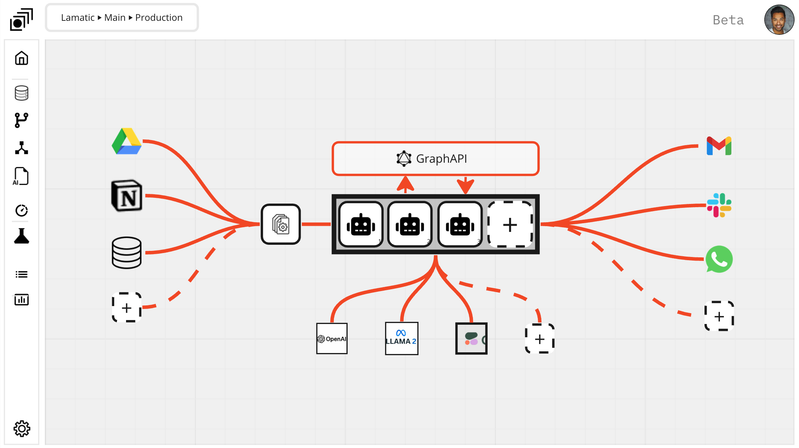
Create a quick win project by using Lamatic’s managed GenAI platform to vectorize and index your company’s policies, procedures, product information, etc. and make it accessible via natural language semantic search using your existing corporate messaging system.
This is a super simple starting point which can create immediate value and lay the groundwork for subsequent quick wins such as an AI-powered new hire onboarding system or an external-facing customer support interface.
Are you ready for a beefy engineering challenge ?
👉🏻 Join the Lamatic team.
